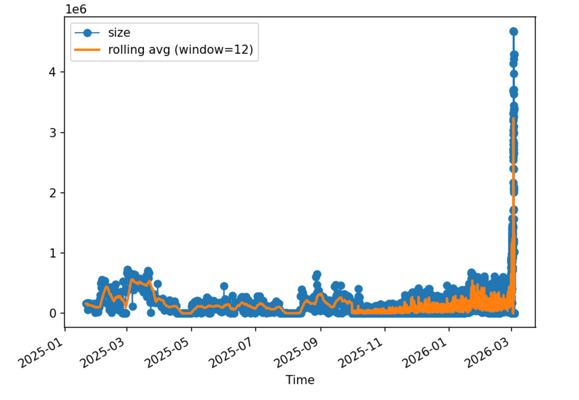
<span id="hs_cos_wrapper_post_body" class="hs_cos_wrapper hs_cos_wrapper_meta_field hs_cos_wrapper_type_rich_text" style="" data-hs-cos-general-type="meta_field" data-hs-cos-type="rich_text" ><p>Periods of geopolitical tension rarely stay confined to borders. They spill into the digital world, where access to information becomes both a tool and a target. Over the past several days, ThreatSTOP has observed a sharp and sustained increase in DNS tunneling activity. The timing aligns with heightened restrictions inside Iran, where citizens are actively seeking ways to bypass internet controls and preserve access to outside communication channels.</p> <!--more--><p>The data shows a clear inflection point. For much of the past year, DNS tunneling detections fluctuated within a predictable range. Recently, volumes have surged dramatically, reflecting a rapid increase in the use of DNS based circumvention tools.</p> <p>This is not a subtle change. It is a structural shift in behavior.</p> <h3><strong>Why DNS Tunneling Is Being Used</strong></h3> <p>When governments impose internet filtering and restrict access to social platforms, messaging systems, or foreign news sources, users often turn to alternative communication methods. DNS tunneling software can be used to:</p> <ul> <li>Encapsulate traffic inside DNS queries</li> <li>Evade traditional content filtering</li> <li>Maintain outbound connectivity through restrictive networks</li> <li>Mask communication as routine DNS activity</li> </ul> <p>For individuals living under restrictive regimes, this technology can represent a pathway to information and speech.</p> <p>However, the technical reality is more complicated.</p> <h3><strong>The Security Risk Behind the Workaround</strong></h3> <p>The same technique that enables circumvention can also enable:</p> <ul> <li>Command and control channels for malware</li> <li>Data exfiltration</li> <li>Peer to peer coordination of malicious activity</li> <li>Distribution of phishing infrastructure</li> <li>Staging for Distributed Denial of Service operations</li> </ul> <p>As tunneling traffic increases globally, organizations outside of Iran are also affected. Many enterprises have employees, contractors, or remote users who may install circumvention software on corporate endpoints. What begins as an attempt to access blocked services can inadvertently create an encrypted tunnel that bypasses corporate monitoring and policy controls. That tunnel does not distinguish between legitimate and malicious payloads. From a security perspective, a rise in tunneling activity means a rise in blind spots.</p> <h3><strong>The Broader Impact on Enterprises</strong></h3> <p>When DNS tunneling becomes normalized traffic, several risks emerge:</p> <ul> <li>Increased attack surface due to uncontrolled outbound channels</li> <li>Reduced visibility into DNS based communications</li> <li>Greater difficulty distinguishing benign circumvention tools from malicious command and control</li> <li>Elevated likelihood of data exfiltration through covert DNS channels</li> </ul> <p>In times of geopolitical stress, adversaries frequently blend into legitimate looking traffic. Increased tunneling usage creates cover.</p> <p>Organizations must protect themselves without overreacting. The objective is not to restrict speech. The objective is to ensure that corporate infrastructure is not unintentionally exposed.</p> <h3><strong>Proactive Protection with ThreatSTOP Protective DNS</strong></h3> <p>ThreatSTOP Protective DNS, delivered through DNS Defense Cloud or DNS Defense, provides proactive protection at the DNS layer.</p> <p>Our ThreatSTOP Security, Intelligence, and Research team continuously develops protections that identify and block:</p> <ul> <li>Known command and control domains</li> <li>Malicious tunneling frameworks</li> <li>Data exfiltration endpoints</li> <li>Peer to peer communication infrastructure</li> <li>Phishing and SPAM distribution networks</li> <li>Distributed Denial of Service staging systems</li> </ul> <p>Protective DNS stops malicious domains before communication occurs. This allows organizations to maintain policy control while preserving operational continuity.</p> <p>DNS Defense Cloud provides protection using ThreatSTOP managed DNS servers in the cloud. DNS Defense enables organizations to apply the same intelligence directly on their own DNS infrastructure. Both models deliver consistent, intelligence driven protection.</p> <h3><strong>Extending Control with IP Defense</strong></h3> <p>Tunneling frameworks often rely on fallback IP based infrastructure. Blocking at the DNS layer is critical, but layered protection strengthens resilience.</p> <p>ThreatSTOP IP Defense allows organizations to manage block lists across routers, firewalls, intrusion prevention systems, AWS WAF, AWS Network Firewall, and other IP based enforcement points. This creates unified protection across multiple control panes from a single intelligence source.</p> <p>By combining Protective DNS and IP Defense, organizations gain:</p> <ul> <li>Coordinated enforcement across DNS and IP layers</li> <li>Rapid deployment of intelligence driven protections</li> <li>Reduced exposure to covert communication channels</li> <li>Greater visibility into suspicious traffic patterns</li> </ul> <h3><strong>Navigating a Complex Environment</strong></h3> <p>The rise in DNS tunneling activity tied to internet restrictions highlights a broader reality. Technology designed for resilience can also be leveraged for risk.</p> <p>Organizations cannot control global events, but they can control how their networks respond to them.</p> <p>ThreatSTOP enables enterprises to maintain proactive protection across dynamic threat landscapes. Whether tunneling traffic originates from geopolitical conflict, criminal innovation, or insider activity, enforcement at the DNS and IP layers reduces risk before compromise occurs.</p> <p>For those interested in joining the ThreatSTOP family, or to learn more about our proactive protections for all environments, we invite you to visit our <a href="/threatstop-platform" rel="noopener" target="_blank">product page</a>. Discover how our solutions can make a significant difference in your digital security landscape. We have pricing for all sizes of customers. <a href="https://admin.threatstop.com/register?hsLang=en" rel="noopener" target="_blank">Get started with a Demo today.</a></p> <p><strong>Connect with Customers, Disconnect from Risks</strong></p> <h2><strong>MITRE ATT&amp;CK Mapping</strong></h2> <table style="border-collapse: collapse;"> <thead> <tr> <th> <p><strong>Observed Activity</strong></p> </th> <th> <p><strong>MITRE ATT&amp;CK Technique</strong></p> </th> <th> <p><strong>Description</strong></p> </th> </tr> </thead> <tbody> <tr> <td> <p>DNS Tunneling for Communication</p> </td> <td> <p>T1071.004 Application Layer Protocol DNS</p> </td> <td> <p>Use of DNS protocol for covert communication channels</p> </td> </tr> <tr> <td> <p>Data Exfiltration via DNS</p> </td> <td> <p>T1041 Exfiltration Over Command and Control Channel</p> </td> <td> <p>Sensitive data transmitted over established DNS channel</p> </td> </tr> <tr> <td> <p>Dynamic Domain Rotation</p> </td> <td> <p>T1568 Dynamic Resolution</p> </td> <td> <p>Rapidly changing domains to evade detection</p> </td> </tr> <tr> <td> <p>Proxy and Relay Infrastructure</p> </td> <td> <p>T1090 Proxy</p> </td> <td> <p>Use of intermediary systems to hide communication origin</p> </td> </tr> <tr> <td> <p>Staging Infrastructure</p> </td> <td> <p>T1608 Stage Capabilities</p> </td> <td> <p>Preparation of infrastructure to support operations</p> </td> </tr> </tbody> </table> <p><br>ThreatSTOP Protective DNS and IP Defense directly disrupt these techniques by blocking malicious domains and IP infrastructure before communication is established.</p></span>